Monday, October 30, 2006

Hamming it up in Santiago

Hi All
 
On the flight down, the plane stopped in Lima, and a very pleasant, handsome Peruvian fellow sat next to me.  He was trained in Lima as an electrical engineer and worked for the United Nations Development Program.  He retired and became a consultant - he looks around forty - and his wife took a job with 3M.  He works at home, she has a five minute commute so that she can take advantage of the Peruvian law allowing her one hour each day to come home and nurse their baby (in addition to one hour for lunch).  Now isnt that civilized?
 
He was flying to Buenos Aires via Santiago on an interesting mission.  The Argentinian government put out a tender for 50,000 computers for students.  Evidently every computer dealer in Argentina was bidding on the deal but the government wanted to avoid any suggestion of favoritism.  So what did they do?  They decided that they were only going to ask for advice from experts who lived OUTSIDE Argentina.  So he was flying in for five days to help make the decision.  Brilliant, yes?   Reminds me of the scene in the movie version of the "Untouchables" where the Judge at the last minute exchanges the tainted Capone jury with the one hearing the unrelated trial down the hall.  I would love to try that out with a couple of Pentagon programs.  Bring on the Canadians!
 
I arrived in Santiago this afternoon, checked in at the lovely Hotel Diego de Velazquez on Guardia Vieja in the Providencia District.   The drive from the airport along a superhighway passes through five miles of tin-roofed shantytowns.   Then the road leads into a very beautiful tree lined city, surrounded by towering snow-capped mountains.  I am sure the folks who came from Bavaria sixty years ago found it just like home.....
 
The first thing I noticed is that other than my two ham radio friends here in Santiago - Dr. Giordano (Dino) Bosami CE3PG and Roberto Vargas Del Villar CE3CDV - not a single person I have met outside the hotel speaks a word of English, and their English is nothing to write home about (well, actually, I guess it is).  Furthermore, nobody - not the hotels, not the kiosks - sell maps of the City.
 
The way to get around is by the subway, the Metro.  The subway is sensational: clean, quiet, orderly, and it runs every two or three minutes.  Since I cannot find a map, I have taken to using my GPS to locate my hotel and the nearby subway stations, so that I can find my way back in a Hansel & Gretel like fashion.   So far, it has worked.   By the way, my Iridium satphone costs one-half as much per minute as the phone in the hotel.  My cellphone, on the other hand, doesnt work at all.
 
After checking in, I picked up Chilean radio licenses for my Antarctic compatriot Alan Cheshire VK0LD and myself and went over to visit the Radio Club of Chile, in another part of town.  Fired up their radio, and spent an hour or so as CE3/K2ARB chatting with hams in Uruguay, Bolivia, Chile, Argentina and of all places, Guinea, Africa.  Had they not closed the Club at 7PM, I would have been operating all night.
 
Going out to dinner now and maybe a movie if I can stay awake.  The stores are fully stocked and not expensive but I have no room in my bags at this stage of the trip.  Will report in tomorrow.
 
Adam   

Check out the new AOL. Most comprehensive set of free safety and security tools, free access to millions of high-quality videos from across the web, free AOL Mail and more.

Friday, October 27, 2006

Rescue at Sea


I thought you folks would be interested in seeing a photograph of the rescue at sea that we coordinated the month before last. We were sailing down from Maine in choppy seas when we found by chance a yacht in distress at dawn in the middle of the Gulf of Maine, far from the shipping lanes. Using our VHF radio, we remained on the scene for three hours to coordinate communications between the stricken vessel, the Coast Guard shore station, the Coast Guard cutter dispatched to the scene, and a nearby vessel in contact with the family of the crew of the dismasted yacht. My brother Dave snapped this photograph of the moment when the Coast Guard arrived, a happy moment for all of us!

Monday, October 23, 2006

Polar Expeditions from Patriot Hills

The base at Patriot Hills is a well-known launching point for expeditions travelling to the South Pole. The trip from PH to the Pole takes anywhere from 40 to 60 days, and since the season is only 87 days long, the expeditioners come in early in the season to get a head start. In fact they will be flying in with me on the first flight on or about November 8th.

Once they jump off, I will maintain a daily schedule of shortwave and/or satphone contacts with each party to make sure that they are safe and on track.


The website at http://www.thepoles.com/ briefly lists this year's Polar expeditions flying into Patriot Hills. More about them when we meet up.

Kiwis on Ice– 2260 km

Kiwis Kevin Biggar and Jamie Fitzgerald will depart from Hercules Inlet hoping to ski to the South Pole and kite back, without resupplies. This would be the first time such a trip is done without airdrops - the 2005 Kites on Ice expedition completed the same 2200km long itinerary, but had a resupply at the Pole.

Kevin (37) and Jamie (26) have not done any polar trip before. But they are used to working as a team – not as polar skiers, but as ocean rowers: In 2003 they won the Trans-Atlantic rowing race.

Expedition’s website: http://www.kiwisonice.org.nz/

Polar Quest - South Pole – 2260 km

Polar Quest team will be the first British Navy group to ski to the South Pole since Captain Scott's expedition in 1912. The current Captain Chapple's team however is determined to enjoy a better fate than their predecessors.

The team will conduct a 2,800 km, 65-day, return ski from Hercules Inlet to the geographical South Pole. The team plans on reaching the SP unsupported, and then kite all the way back (it is unclear if they will get a resupply upon arrival at the Pole though).

Members have been selected among the most experienced ranks of the British Naval service. The Polar Quest South Pole expedition members are Sean Chapple (leader), Pollyanna Hatchard, Craig Hunter, Paul Martin, Ross Cane, and Andrew Brown.

Earlier this year, Captain Chapple led four Royal Navy novices to the Magnetic North Pole. The team arrived on April 30 after a 26 day, 240 km trip.

Expedition’s website: polarquest.co.uk

Hannah McKeand- solo, unsupported for Geographic South Pole (1130 km)

After reaching the South Pole in 2004/05 season as member in a supported team, British Hannah McKeand is back to Antarctica – by sea and ice.

In October Hannah will board the Blizzard sailboat off the southern coast of Tasmania for a trip to the Magnetic South Pole. Right after, she will go for the “other” South Pole – the Geographic one.

The plan is simple: Ski the 730 miles to the South Pole, solo and unsupported in a record time of 40 days.

Hannah plans to land at Patriot Hills and practice for two weeks; skiing to Hercules Inlet and back - before going for the Pole.

Hannah's website: http://www.adventurehannah.com/


Southern Reach - 1130 km

Southern Reach, a team of 7 British Royal Air Force men, will attempt to reach the Geographic South Pole unsupported. The team hopes to complete the 700-mile trek in 50 days: If everything goes according to plans, they will depart from Hercules Inlet on November 8 and will reach the Pole by December 27, just in time for a Polar New Year’s Eve.

Southern Reach team leader is Warrant Officer Al Sylvester; deputy leader is Lain Kirk; other members are Flying Lt. Kevin Scully, Squadron Leader Kev Eaton, Corporal Phil Mainprize, Sgt. Ian Stewart and Corporal Mike Beveridge. Some of them serve in rescue corps; and all are keen outdoorsmen.

Expedition’s website: http://www.southernreach.co.uk/


Measuring Antarctica

In August, the USGS Advisory Committee on Antarctic Names (ACAN) approved 48 new names for features on and around the Vinson Massif in the Sentinel Range including 4 mountains and 14 peaks. Nine of the peak names were proposed by Damien Gildea. Now the Aussie climber and skier is returning to Antarctica for the seventh straight year; to again measure the mountains he climbs. One of the summits he hopes for this season is the highest unclimbed peak in the Sentinel Range.

Teaming up with Damien is usual climbing mate Chilean Camilo Rada - a newcomer this year is also Jed Brown from Alaska. Jed is a climber but also a math wiz who works at UAF with computer modeling of the Antarctic ice sheet. A fourth member might be confirmed later.


Tuesday, October 03, 2006

Sunscreen and goggles - 6,000 miles south of the Equator?


As today's satellite photo from NASA demonstrates, an enormous hole in the ozone layer of our atmosphere continues to persist over the Antarctic. Within the outlines of this hole, ultraviolet rays fall on the surface of the Earth with full force.

Epidemiological studies by the World Health Organization have demonstrated that excessive exposure to ultraviolet radiation from the Sun materially increases the incidence (among the unprotected, at least) of malignant melanoma, squamous cell carcinoma, basal cell carcinoma, squamous cell carcinoma of the cornea, and cataracts.

I figure that with a lifetime of sailing, I had used up whatever exposure allowance I had coming. So with the advice of a dermatologist and mountaineering experts, I purchased the highest value sunscreen I could find (70 PSF), the darkest sunglasses available (with 100% UV protection and 95% reduction in sunlight), and a noseguard.

The hole in the ozone layer is entirely man made. Chlorofluorocarbons (CFC's) released from air conditioners and aerosol cans are the culprit. Scientists recently reported that international treaties agreed to in 1996 have stabilized the amount of CFC in the atmosphere and they hope that this wound in the earth's atmosphere will ultimately heal itself.

Gear:

Julbo Colorado Alti Spectron X6 Sunglasses
http://www.altrec.com/shop/detail/17931/

Hawaiin Tropic oz.one Sunblock SPF#70 4 oz.
http://www.amazon.com/exec/obidos/ASIN/B000H8DUUW/sz-category77-20/ref=nosim

Beko Nose Guard
http://www.guideschoice.com/scripts/prodView.asp?idproduct=12

Sources:

http://www.who.int/mediacentre/factsheets/fs305/en/index.html
http://www.ozonelayer.noaa.gov/science/basics.htm
http://toms.gsfc.nasa.gov/

Sunday, September 24, 2006

Thursday, September 07, 2006

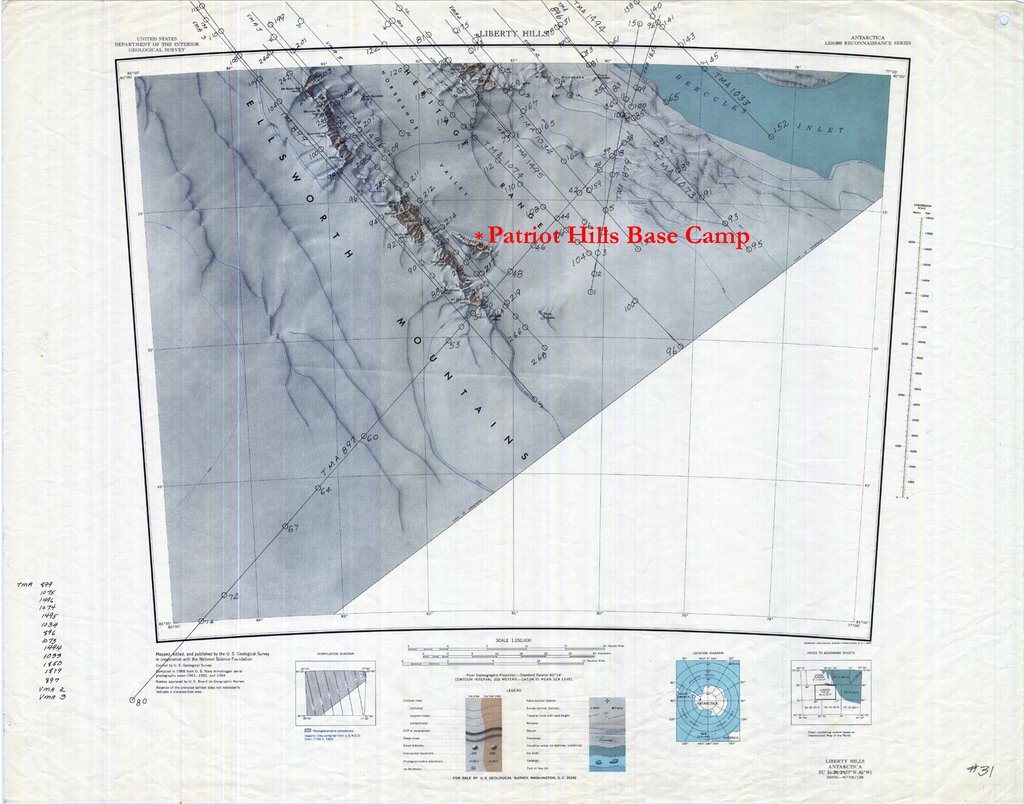
USGS Topo Map of Patriot Hills Region (Oriented North)


Here is a US Geological Survey topographic map of the region immediately surrounding Patriot Hills, which I hope to explore in my rare days off. The base camp is in the center of the map, about a third of the way down. I hope to help install a VHF repeater up in the hills to increase the coverage area for VHF handheld radios used to communicate with staff and expeditions.

As it will be difficult to send images once I reach Patriot Hills, I will refer to this and other online maps and photos as a reference in future blogs. I recommend that those of you following along download the detailed and far more useful (not to mention beautiful) version of this map found on the Web at http://usarc.usgs.gov/drgs/c80077s1.jpg

US Navy Aerial Photo of Patriot Hills: Facing Northwest


Patriot Hills is the small set of hills in on the right. The katabatic winds come whipping down from the 9,000' elevation at the Pole (left to right in the photo) and blow the snow off the ice on the downwind side, creating one of two "blue ice" runways in Antarctica.
This one is 7,500 feet long by about 160 feet wide, enabling it to handle craft as large as the chartered Ilyushin 76 jet that arrives weekly (weather permitting). The jets are flown on their ten-hour round-trip journey by Russian crews with whom I will be speaking enroute from Chile via HF (Shortwave) and Iridium satphone.
What makes it complicated is that the katabatic winds blow perpendicular to the runway and Ilyushins, with their big tails, do not cotton to crosswinds above 18 knots, so the key decision is the "go or no-go" one that must be made before the plane departs Chile. Patriot Hills has a full-time meteorologist on staff who will sit in the same hut as I. He will rely on various sources of weather information, including automated weather stations set up by Stanford University a hundred miles or so upwind towards the Pole.

Gigi Says: "Good Thing They Didn't Ask Me If You Can Cook!"

The folks in Antarctica had a pretty definite idea of what they were looking for. Aside from cooking, Gigi said that this was a job I had preparing for my entire life. Here is the hiring criteria they had prepared:

· Native English language speaker. If not native, then a demonstrated high oral proficiency in
English with no heavy accent that would impede clear voice communications over radio

· Previous experience with aircraft operations involving fixed wing aircraft and / or helicopters using long haul HF SSB and short haul VHF AM or FM voice circuits.

· Demonstrated ability operating modern HF Single Side Band & VHF radio receivers and transmitters.

· Demonstrated ability with standard ITU radio procedures, codes and log keeping

· Demonstrated ability with standard ITU Distress, Urgency & Safety communications procedures

· Demonstrated ability to operate satellite equipment for voice and data calls. Understanding of satellite orbits, especially differences between geostationary and polar orbits and associated advantages / limitations.

· Ability to touch type (or otherwise type reasonably fast)

· Commercial Radio Operator License, Unrestricted (Full) Amateur License.

· First Aid certificate

· Understanding of HF (ionospheric) and VHF (line of sight) propagation & limitations

· Understanding of HF & VHF antenna theory. Able to diagnose and rectify simple antenna faults using basic test equipment and tools

· Familiar with and able to use basic radio test equipment such as Voltage Standing Wave Meter, Power Meter, Volt Meter etc.

· Demonstrated ability to use a soldering iron

· Able to understand block and circuit diagrams and diagnose major equipment & component faults (such as blown transistors, short circuit diodes, open fuses, short circuit capacitors, burned out resistors etc.) using basic test equipment

· Understanding of solar panel technology & its limitations (such as max. current per unit of solar radiation / insolation angle etc.), DC Voltage regulators DC – AC converters

· Understanding of different types of batteries (Lead Acid wet & gel, Nicads, Nickel Hydrides, Lithium Ion, Lithium Polymer etc. and the different charging regimes.

· Understanding of Specific Gravity & able to use hygrometer to diagnose when a battery has past its “useful service life” (i.e. not holding charge, not able to deliver sufficient power at a specified current etc.)

· Able to diagnose and rectify simple faults in power supplies, voltage converters, chargers & batteries.

· Understanding of (and able to tell the difference between) natural and man-made interference, how it is caused and general methods used to reduce or eliminate it

· Computer skills: Intermediate computing knowledge. ALE uses PCs, mostly running Windows OS, some using LINUX.

· Computer skills: Proficiency using Microsoft Office suite (Word, Excel etc.) Able to assist others in ‘helpdesk’ style tasks.

· Computer skills: Familiarity with main web browsers (Internet Explorer, Mozilla, Netscape, etc.)

· Computer skills: Familiarly with main email clients. POP3 and similar

· Mechanical skills such as able to repair or make simple metal or wooden articles using basic mechanical tools (drill, hacksaw, file, taps & dies etc.)

· Understanding of and / or previous experience using HF data modes such as Pactor, or Amtor.

· Computer applications knowledge in common packages such as Microsoft Word & Excel (i.e. “help desk” type skills – assisting staff & clients with problems associated with using a particular applications package, rather than dealing with a software bug or loading problem).

· Computer networking skills, knowledge of Ethernet, TCP/IP, Ping command & Wireless LAN,

· Able to set up peripherals such as printers, scanners, digital cameras etc.

· Understanding of data protection and confidentially issues

· Rigger experience, e.g. able to use a gin pole, swage machine, turnbuckles, bulldog grips, D shackles etc. Understanding of mechanical stress, strain, guying techniques, pulleys etc.

· Language abilities in Spanish or Russian

· Proficiency in Morse Code (any speed)

· Communications Tower Rescue training or experience

· Mountain Rescue or similar “Search & Rescue” type training or experience (such as Fire Brigade, Police, Armed Forces, National Guard, State Emergency Services)

· Understanding of meteorological instruments & observations, experience with AWS

· Cooking Skills

· Advanced First Aid / Paramedic skills

Tuesday, September 05, 2006

The E-Mail From Australia That Hooked Me


To: Antarctica List
From: Alan Cheshire
Subj: Job Opportunity - Antarctic Radio Operator
Date: 8/14/2006 10:00:25 PM Eastern Standard Time

I am looking for someone for a temporary position as a radio / communications operator at Patriot Hills, Antarctica this coming season. The job involves maintaining voice communications with Twin Otter aircraft and mountaineering parties on HF, VHF and Iridium satellite. This would suit an experienced HF amateur radio operator and is a paid position with airfares to/from Punta Arenas provided. Patriot Hills is located at 80 degrees South, at the southern end of the Ellsworth Mountains and is serviced by a weekly 5 hour flight on an Ilyushin 76 cargo jet from Punta Arenas, Chile. Accommodation, food etc.at Patriot Hills is provided free of charge. Dates are approximately mid October 2006 to end of January 2007, but a shorter period may be negotiated for suitable candidates. The position requires very good English language skills and a reasonable level of fitness. Initial expressions of interest to me via my email address.
73, Alan VK6CQ / VK0LD / VP8PJ / 9V1DX

Monday, September 04, 2006

My Journey

During the third week of October, I am heading down to the Antarctic interior for three months where I'll work as a Communications Officer at a remote field camp called Patriot Hills, about 600 or so miles from the Pole. I have dreamed of working in Antarctica since I was fourteen years old, and when the possibility of fulfilling this dream came 38 years later in the form of an email from Australia about two weeks ago, I was powerless to resist. Gigi and the entire family have been enthusiastically supportive. There is no Internet access at the base but there is limited access to email, so I have established this blog to keep you all up to date. Please feel free to post comments. Adam